
I was sitting in a session recently, looking at a virtual room filled with brilliant African women, when Victory said something that stopped me cold. She didn’t say she was struggling to learn. She didn’t say she lacked talent. She said she was “stuck” because she had too many skills.
Victory is a microcosm of the modern professional. She had the copywriting, the social media management, the technical writing, and the marketing background, but she felt like she was standing in front of a massive buffet with no plate. She had everything to give, but nowhere to start. As she spoke, I saw a mirror of my own early journey. I recognized that specific brand of exhaustion that comes from being “good at everything” but known for nothing. It’s a quiet anxiety. While the world shouts about the “AI boom” and “limitless productivity,” the person in the trenches feels like they are drowning in the “how” while losing sight of the “why.”
This is the paradox of talent in the age of automation. We are told these tools will save us time, but for most, they have just added more noise to the signal. You have a bucket of tools, a dozen open tabs on YouTube, and a nagging feeling that despite all these “productivity boosters,” you aren’t actually building anything that moves the needle for a business. You’re collecting prompts like they’re digital souvenirs, but you aren’t achieving results. We didn’t start this mentorship to add more lines to a crowded resume; we started it to turn that “overload” into an “offload” that actually pays.
The excitement of new technology is almost always followed by a paralyzing realization: having the tools is not the same as having a blueprint. Most people are spectators in a revolution that demands builders. If you are a woman trying to navigate this landscape, you aren’t just fighting the learning curve of a new app; you’re fighting the weight of “manual thinking” and the pressure to be a “full-stack” human who manages church, children, and deadlines simultaneously. We wanted to move past the hype and into the architecture of execution.
Why 90 Days, Why Ladies, and Why 1app?
When we looked at the scope of AI training, we noticed a glaring problem: businesses have AI, but they can’t tie it to business results. Professionals are “prompting”, asking a chatbot to write a generic email, but they aren’t “stacking.” Stacking is the art of combining different AI tools to achieve a single, high-value business outcome. It’s the difference between a toy and a tool. If you can’t connect the dots between ChatGPT, Zapier, and a client’s revenue, you aren’t an AI specialist; you’re just a user.
We chose a 90-day duration because you cannot unlearn a decade of “manual thinking” in a weekend workshop. You have to move from watching to doing. It takes time to break the habit of doing things the hard way. We focused on a female-only cohort first because we wanted to change the experience of the burden of the “too many skills” paradox. Many people are juggling fractional roles, family responsibilities, and the societal pressure to be the quiet backbone of every project. We needed a space where “non-tech” wasn’t a label of limitation, but a starting point for a different kind of architecture.
The partnership between Valucop Global and 1app served as the engine behind this movement. We needed a framework that moved beyond the hype and into the reality of the African market. We wanted to prove that you don’t need a computer science degree to build software-as-a-service (SaaS) prototypes or cinematic marketing campaigns. You just need to know how to direct the machine.
The Behind-the-Scenes: Chronology of a Movement
The rhythm of the program was designed to mirror the reality of a working professional’s life. We claimed 8 PM on Mondays for our live teaching sessions and 8 PM on Wednesdays for office hours. Why 8 PM? Because life in Africa doesn’t stop for a webinar. Work happens. Church happens. Children happen. We needed a time when the world quieted down enough for these women to focus on building their futures.
Our philosophy was “learning by doing.” This wasn’t a “watch me and go home” setup. If we were in a session, we were practicing. We even pushed through Easter Monday. Some might call that intense, but the future of work doesn’t wait for the holidays. We were in a race to bridge the gap between “information” and “implementation.”
The journey was a gauntlet of breakthroughs and logistical hurdles:
- The Struggle with Information Overload: Early on, participants like Idongesit expressed feeling overwhelmed. She was catching up on school deadlines and work, feeling the weight of “too much to learn.” We had to pivot her mindset from “learning everything” to “auditing the bucket.” We moved from consuming content to extracting assignments.
- The COTA Formula Breakthrough: Everything changed when we introduced the COTA formula: Context, Objective, Task, and Action/Adjectives. Before COTA, the women were getting generic, robotic responses from AI. After COTA, they were getting high-fidelity outputs. By providing the AI with the right Context (who are you?), a clear Objective (what is the goal?), a specific Task (what exactly are we doing?), and the right Action/Adjectives (what is the vibe?), their work began to sound human, professional, and targeted.
- The “Stacking” Realization: We moved from simple chats to using Zapier, Google AI Studio, and V0. We weren’t just writing; we were building automated research workflows and landing pages without touching a single line of code. We experimented with Valucop Studios, my own AI-driven storytelling channel, to show them that a woman in her living room could be a director, a scriptwriter, and a music producer.
- The Monday Hustle: I remember the 8 PM sessions where we’d be deep in the weeds of prompt engineering while children played in the background or generators hummed in the distance. That is the reality of the African builder. It’s not a sterile Silicon Valley office; it’s a dining table at night, fueled by data bundles and pure grit.

What Actually Changed: The Story Behind the Evidence
Impact isn’t measured by how many videos you watch; it’s measured by what you build when the screen goes dark. Throughout the 90 days, we saw the transition from generic AI use to what I call “Cinematic Execution.”
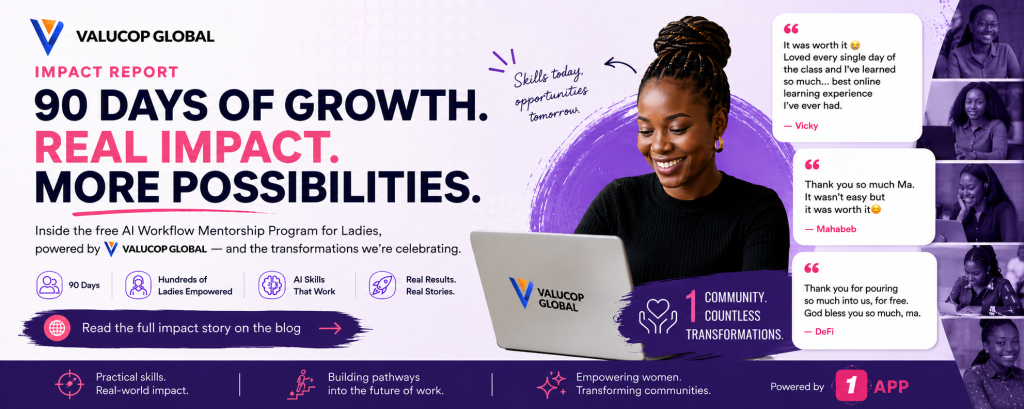
We onboarded 47 women to the program. By the time we hit the 90th day, 15 had stayed the course from day one, completing at least 8 proof-of-work assignments. They didn’t just passively watch tutorials; they actively built real things. Across those three months, they mastered prompt engineering frameworks and built functional, no-code landing pages and portfolios using platforms like v0 by Vercel,bolt.new, Hercules. They deployed AI agents like Manus AI, Apify, and Claude Code for deep market research, SWOT analysis, and web scraping to find target leads and jobs. We covered how to connect and automate tedious workflows with Zapier and Gumloop; generate and distribute original AI music using tools like Suno and HIGHVIBES, and clone voices to create digital twin avatars for faceless YouTube channels.
They even learned how to direct cinematography for storytelling and UGC marketing videos, build domain expertise with Gemini Gems, design UI/UX with Google Stitch, and navigate the ethics of always keeping a “human in the loop”. These ladies went from feeling overwhelmed by the AI revolution to actively building MVPs and practical fractional career pathways.
The Photographer’s MVP
We didn’t just talk about “AI for business.” We built a prototype for an AI Studio for Photographers using Hercules and Google AI Studio. The goal was to solve a real problem: transforming blurry screenshots or low-quality images into professional shoots with a single button. We architected a workflow where a photographer could upload a reference image, and the AI would identify the subjects, apply a clean background, and restore the quality without touching the “mathematically untouched” features of the human face. This wasn’t a theoretical exercise; it was a demonstration of how a “non-tech” woman could architect a SaaS idea in an afternoon.
Cinematic AI Storytelling
We moved beyond making “AI videos” and started directing. We used Google Flow to manage storytelling consistency. The women learned to use cinematography language, slow dollies, tracking shots, shallow depth of field, and low-angle POV shots.
Participant Spotlight: Elsa, who initially struggled with maintaining character consistency across scenes, successfully generated a complete video ad for a friend’s brand. She moved from “just putting a prompt in” to understanding how to extend scenes in Google Flow, adding 8-second increments to create a natural narrative flow. She proved that with the right “Human in the Loop” direction, AI can produce work that rivals traditional agencies.
Original Music Production
One of the most high-impact moments was our venture into music. We used AI to create original, three-minute soundtracks with Nigerian and Igbo accents. We didn’t want the generic “American AI” sound. We wanted the vibe of home. We created a satirical song about the state of the country, “Mama praying in the corner, soft and low”, with a “hopeful yet tiring” team voice. By specifying the accent as “Nigerian/Igbo” in the prompt, we broke the mold of standard AI audio. We proved that we could create original, copyright-free soundtracks for movies and ads right from our laptops.

A Playlist of our sessions during the program
Links to some of the ladies’ works at different times in the program
Victory: https://www.youtube.com/shorts/mg8gbhBBD_E
Ogechi: https://youtu.be/QtKb6Aw61QE?si=gyWBJaWUA4swkJY-
Ogechi: https://futureweb3.netlify.app/
Ogechi: https://youtube.com/shorts/nKyQC4J7NHc?si=S_srpPNreKRZoHHs
Chitel: https://x.com/ChitelOpara/status/2046605245719904293?s=20
Vivica: https://www.flowmusic.app/song/db88f4e3-bb37-41da-8a7c-1ef4fff953c6
Vivica: https://dog-sound-interprete-inh0.bolt.host/
Vivica: https://www.tiktok.com/music/original-sound-7646770333736094471?is_from_webapp=1&sender_device=pc
Promise: https://youtube.com/shorts/oiowG49NWY8?si=aICVcp2r5mbT4NTc
Vivica: https://youtube.com/shorts/9fqwuvX5U0Q?si=6gtoJ7gXJxaiNxtZ
And many more…
Five Lessons I Learned Coaching This Program
Building this mentorship taught me as much as it taught the participants. If you are a leader or a founder looking at the future of work, these are the truths you cannot ignore.
I. Results Over Intentions
I once worked for an agency boss who told me, “Victoria, you aren’t paid for your intentions; you’re paid for your results.” At the time, it felt harsh, but in the AI era, it is the ultimate law. A business owner doesn’t care if you spent six hours fighting with a prompt. They care if the workflow you built solved a problem. AI allows us to compress time, but only if we focus on the outcome. We must train for “result-based execution.” When you stop telling a client “I am trying” and start saying “Here is the automated workflow that solves your bottleneck,” your value triples overnight.
II. The “Skill Audit” Necessity
If you have a thousand skills, you have no brand. I challenged every woman in the program to do a “Skill Audit.” You have to find your “Ageless Core” the thing you are known for regardless of whether the tool is Web2, Web3, or AI. For Victory, it was Translation: the ability to take complex technical jargon and make it simple for a human audience. Once she identified that core, her copywriting, social media, and AI skills all became sub-tools under that one umbrella. You aren’t a “social media manager”; you are a “Distribution Architect.” Auditing your “bucket of skills” allows you to stop being a generalist and start being a specialist who uses AI to handle the grunt work.
III. Human in the Loop
AI is a blessing, but it is a “dumb” blessing without a human director. Your AI results are only as good as your cinematography knowledge, your understanding of brand voice, and your ability to spot a “hallucination.” We spent hours learning the STAR formula (Situation, Task, Action, Result) for our portfolios because we needed to show the human logic behind the machine output. The goal isn’t to replace the human; it’s to elevate the human to the role of the Architect. If you don’t understand the fundamentals of marketing or design, AI will only help you produce bad work faster.
IV. The Fractional Future
The traditional 9-5 is evolving. We are moving toward a “Fractional Future” where professionals hold multiple “retainers” rather than one job. AI makes this possible. By using AI workflows to do 10 hours of work in one, a woman can handle three or four fractional roles simultaneously. This is how we build wealth in the new economy. Instead of begging for one full-time salary, our participants are learning to offer specific “results-as-a-service” to multiple clients. This is the path to true professional independence in Africa.
V. Simplicity is the Ultimate Sophistication
You don’t need to learn Python to build the future. By “stacking” no-code tools like Zapier, Google AI Studio, V0, and Google Stitch, we turned “non-tech” women into builders. Google Stitch allowed us to create UI/UX designs for mobile apps in seconds, work that used to take a week in Figma. If you can prompt it, and you understand the logic of the workflow, you can build it. Simplicity in execution is what allows for speed in the market. Don’t overcomplicate the tech; over-deliver on the solution.
Why This Matters: The African Context
For Africa, AI isn’t just another tech trend; it’s a bridge. For decades, our continent has watched from the sidelines as other regions built the infrastructure of the internet. We were the consumers, the “outsourced” labor, the spectators. But AI? AI is the great leveler. It doesn’t care about your physical location; it cares about the quality of your direction.
At Valucop Global, our vision is to ensure that Africa doesn’t just “use” these tools but builds the “practical pathways” into the future. When a woman in Enugu learns to combine AI music production with cinematic storytelling to sell a local brand to a global audience, the borders disappear. This program was about giving African women the keys to a kingdom that was previously locked behind the gates of “coding” and “technical expertise.” We are moving from a history of watching to a future of building. AI is the “blessing” that allows us to bypass decades of infrastructure deficit and compete on a global stage.
The Final Thought
We started this journey with women who felt “stuck” by the very talents that should have set them free. They had the “too many skills” paradox, a buffet of talent with no plate. We ended it with builders.
Visibility is something you must engineer for yourself. You don’t wait for an opportunity; you build a portfolio so undeniable that the opportunity finds you. Whether it’s through a faceless YouTube channel, a fractional marketing role, or an AI-powered design studio, the goal is to be seen as a person who delivers results, not just someone who “knows AI.”
Victory started with a bucket of skills and no blueprint. She ended with the ability to architect entire business solutions. That, more than any certification, is the real transformation. The world doesn’t need more people who can “use” AI. It needs people who can stack tools to solve human problems. To the women of Africa: the tools are in your hands. Now, go and build.